
Colorado schools identify autism in 1 in 64 students
Colorado public schools report 13,654 students with autism as their primary special education category, or 15.7 for every 1,000 students enrolled.
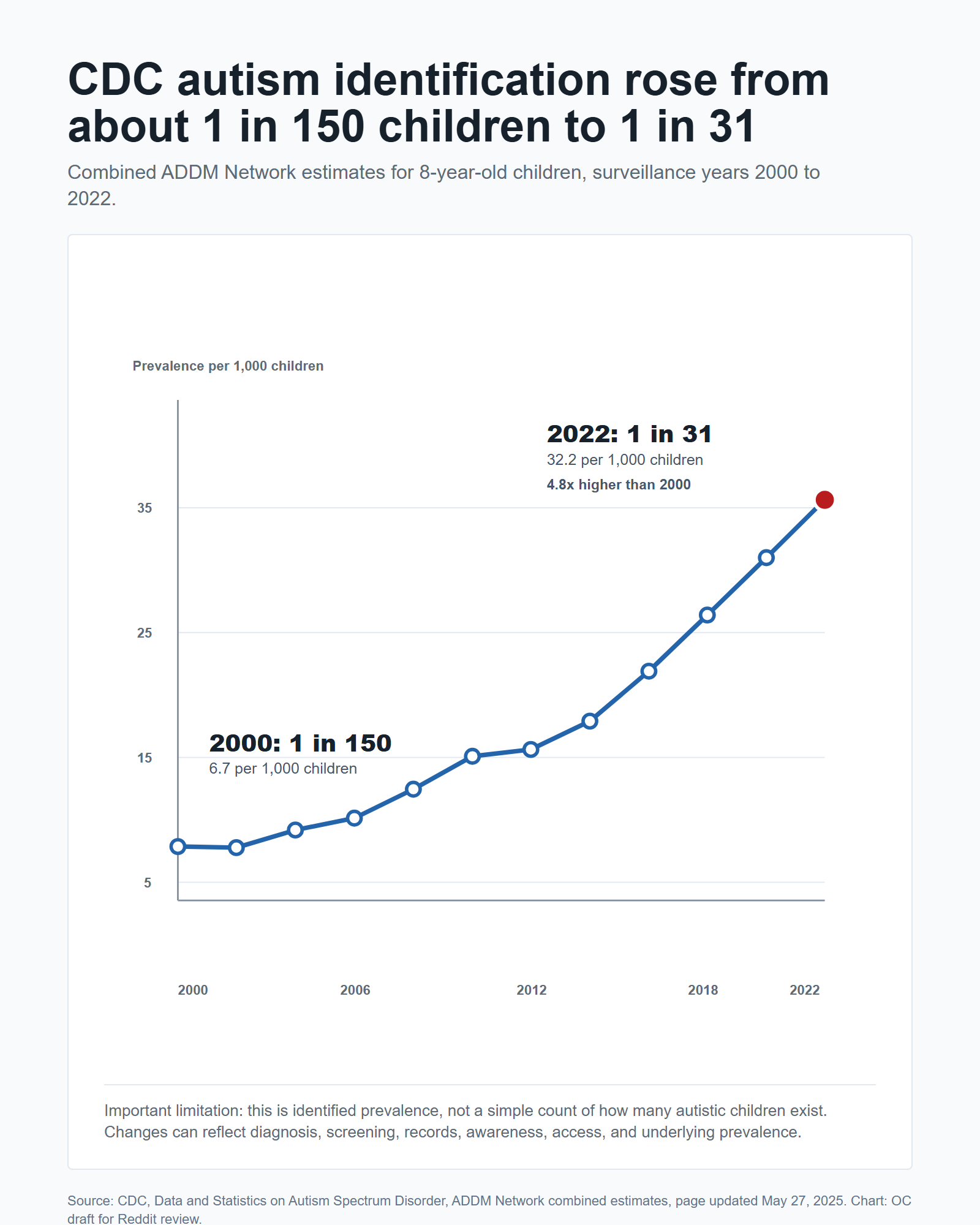
CDC surveillance puts autism prevalence at 32.2 per 1,000 children, about 1 in 31. Here’s what sits inside that two-fold gap.
Colorado’s school identification rate is 15.7 per 1,000 students. CDC’s multi-site prevalence estimate is 32.2 per 1,000 children.
On this page
What do Colorado schools report?
In 2024-25, Colorado reported 13,654 students ages 3 through 21 whose primary special education eligibility is autism. Against an enrollment of 870,793, that’s 15.7 per 1,000 students, or roughly one child in every 64.
How does that compare to CDC prevalence?
The CDC’s monitoring network found autism in 32.2 of every 1,000 eight-year-olds in 2022, the figure usually quoted as 1 in 31. Site by site it ranged from 9.7 per 1,000 in Laredo, Texas to 53.1 in California.
Colorado isn’t one of the 16 monitored sites, so nobody has published a Colorado prevalence figure. What we can say is that our schools identify autism at roughly half the national surveillance rate.
Why don’t these numbers match?
They measure different things, and that matters more than the gap itself. A school eligibility category is an administrative decision about services, while CDC prevalence is a research estimate built from health and school records.
Plenty of autistic students are counted under a different primary category, like speech or language impairment, and some need no special education services at all. The 16 CDC sites also aren’t a national sample, and their own tenfold spread proves how much identification varies by place.
So the honest read isn’t that thousands of Colorado children are missing a diagnosis. It’s that school labels and clinical prevalence count different populations, and neither one alone tells a parent whether their own child should be evaluated.
Methodology
Autism counts come from the U.S. Department of Education’s IDEA Section 618 collection for 2024-25, extracted July 30, 2025. Enrollment is Colorado’s October 2025 count of 870,793 preK-12 students, the most recent published; the two sit one school year apart, which moves the rate by about 0.2 per 1,000. Prevalence comes from the CDC’s ADDM Network report covering 2022, published April 2025.
Our rate divides the state autism count by state enrollment. The Department of Education publishes its own differently-built figure, 9.4 per 1,000 for ages 5 through 21, measured against resident population rather than enrollment. On that measure the gap against CDC is wider still, closer to threefold. Because our counts span ages 3 to 21 while CDC surveyed eight-year-olds, read any version as directional.
Cite this: Budding Futures ABA analysis of U.S. Department of Education IDEA Section 618 child counts (2024-25), Colorado Department of Education enrollment (October 2025), and CDC ADDM Network prevalence (2022 surveillance year). Published August 14, 2026.
What should parents take from this?
A school eligibility decision is not a medical diagnosis, and neither one replaces the other. Your child can qualify for school services without a clinical diagnosis, and can have a diagnosis without qualifying at school.
If you’re waiting on either one, don’t wait to act. Our guide to first steps after a diagnosis in Colorado covers the sequence, and Budding Futures ABA can start early intervention at home while the paperwork catches up.
Frequently asked questions from parents
Q: How many students in Colorado have autism?
A: 13,654 students ages 3 through 21 had autism as their primary special education category in 2024-25, which is 15.7 per 1,000 enrolled students.
Q: What is the autism rate in Colorado?
A: No published prevalence figure exists for Colorado, because the state isn’t a CDC monitoring site. Colorado’s school identification rate is 15.7 per 1,000 students; CDC’s multi-site prevalence estimate is 32.2 per 1,000 children.
Q: Does a school autism label mean my child is diagnosed?
A: No. School eligibility is an educational decision about services. A medical diagnosis comes from a clinician, and each can exist without the other.
Q: Can I use these numbers?
A: Yes, with attribution. Use the citation line above and link back so readers can review the methodology and caveats.
ABA therapy support near you
In-Home ABA Therapy Across Colorado
How Budding Futures delivers BCBA-led ABA at home across Colorado.
ABA Therapy in Colorado Springs
In-home, BCBA-led ABA for Colorado Springs families.
ABA Therapy for Kids in Thornton
In-home ABA therapy for Thornton families.
Wondering whether your child should be evaluated?
Tell us what you’re seeing at home. We’ll explain how evaluation works in Colorado, what ABA would target, and how coverage works.