
How many BCBAs are in Colorado?
Colorado has 1,889 board certified behavior analysts and 8,110 registered behavior technicians, which works out to 7.2 autistic students per BCBA.
That’s the fifth strongest ratio in the United States, where the average state has 15.1. We calculated it ourselves, and here’s exactly how.
7.2 autistic students per BCBA in Colorado, against a 15.1 national figure and a range from 5.7 in Hawaii to 43.0 in Minnesota.
On this page
Colorado’s behavior analyst numbers
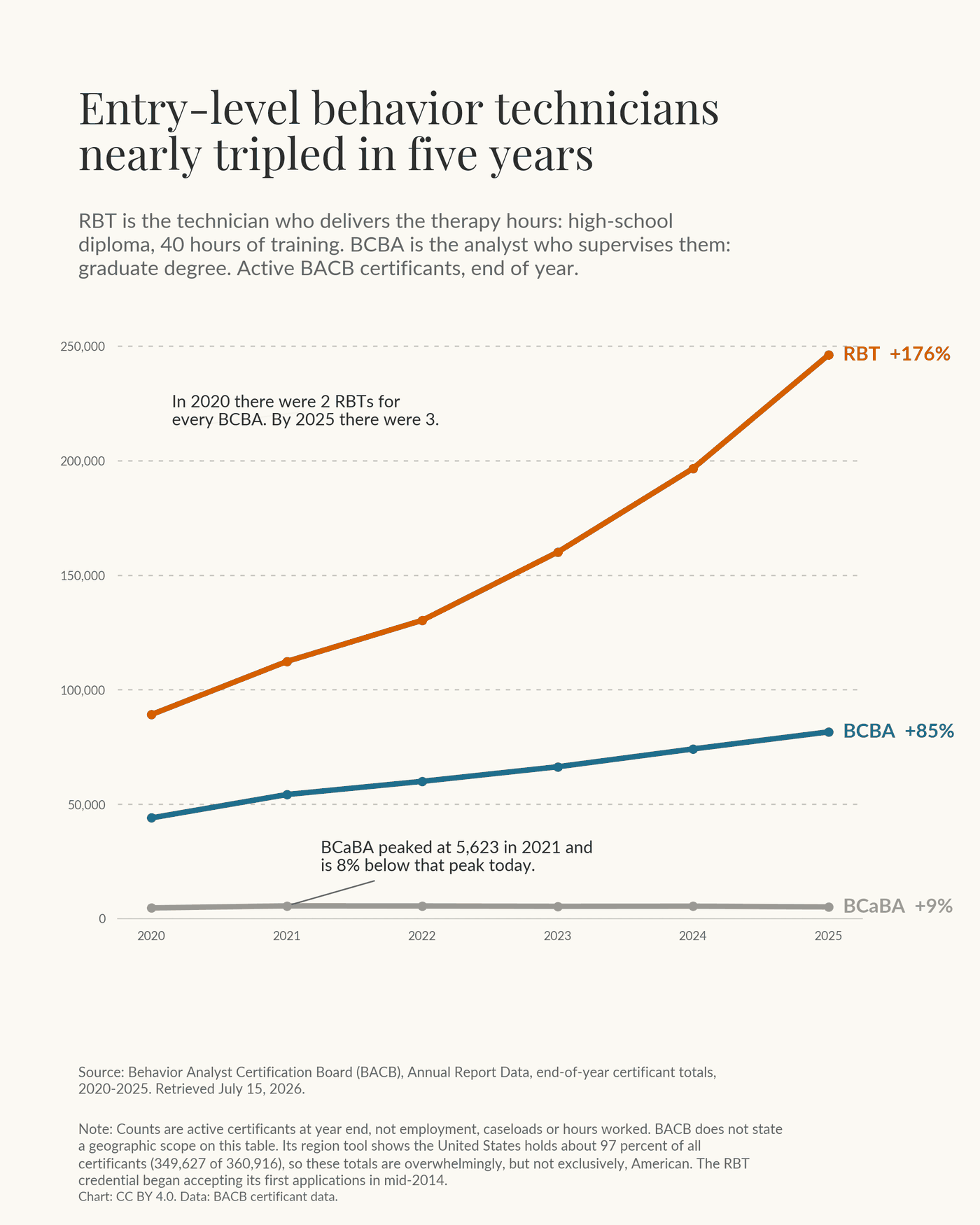
The BACB’s certificant dashboard lists 1,835 BCBAs plus 54 doctoral-level BCBA-Ds in Colorado, along with 4,459 assistant analysts nationally and 8,110 RBTs here at home. That’s 4.3 technicians for every analyst in the state.
Colorado schools reported 13,654 students ages 3 through 21 with autism as their primary special education category in 2024-25. Divide one by the other and you get 7.2 students per analyst.
How does Colorado compare to other states?
| Rank | State | Autistic students per BCBA |
|---|---|---|
| 1 | Hawaii | 5.7 |
| 2 | New Hampshire | 6.1 |
| 3 | Vermont | 6.4 |
| 4 | Florida | 7.0 |
| 5 | Colorado | 7.2 |
| n/a | All states combined | 15.1 |
| 48 | Mississippi | 31.6 |
| 49 | District of Columbia | 33.6 |
| 50 | Minnesota | 43.0 |
The spread is the story. A family in Minnesota shares its analyst pool with six times as many autistic students as a family in Colorado does.
What this ratio doesn’t tell you
Certification isn’t geography. An analyst certified in Colorado may work in Denver, in a rural district, in research, in a school, or not clinically at all, and the dashboard doesn’t say which.
The two counts also come from different years and different populations, since plenty of analysts serve children who aren’t in the school count. Read this as a supply signal, not a capacity guarantee.
Methodology
Numerator: autism-category child counts, ages 3 through 21, from the U.S. Department of Education’s IDEA Section 618 collection for 2024-25, extracted July 30, 2025. Denominator: BCBA plus BCBA-D certificant counts from the BACB regional dashboard, retrieved August 13, 2026. Iowa is excluded because its autism count is suppressed for data quality.
Both figures are published counts, not estimates. BACB’s quarterly press totals differ slightly from its live dashboard, and we used the dashboard because it’s the only source broken out by state.
Cite this: Budding Futures ABA analysis of BACB certificant data (August 2026) and U.S. Department of Education IDEA Section 618 child counts (2024-25). Published August 14, 2026.
What this means for Colorado families
A long wait for therapy isn’t inevitable here, because the analysts exist. When a Colorado family is told the only option is a year-long waitlist, that’s a statement about one provider, not about the state.
Budding Futures ABA is part of that supply. Clinical Director Rachel Blackburn, BCBA leads plans delivered in your home across Colorado, and we keep availability current instead of parking families in a queue.
Frequently asked questions from parents
Q: How many BCBAs are there in Colorado?
A: 1,835 BCBAs plus 54 doctoral-level BCBA-Ds, per the BACB certificant dashboard retrieved August 13, 2026. Colorado also has 8,110 registered behavior technicians.
Q: Does Colorado have a BCBA shortage?
A: Less than most states. Colorado’s ratio of 7.2 autistic students per analyst ranks fifth nationally, against a 15.1 average. Local access still varies a lot between metro and rural areas.
Q: Which state has the fewest behavior analysts per child?
A: Minnesota, at 43.0 autistic students per BCBA, followed by the District of Columbia at 33.6 and Mississippi at 31.6.
Q: Can I reuse these figures?
A: Yes, with attribution. Use the citation line above, and please link to this page so readers can check the methodology.
ABA therapy support near you
In-Home ABA Therapy Across Colorado
How Budding Futures delivers BCBA-led ABA at home across Colorado.
ABA Therapy in Colorado Springs
In-home, BCBA-led ABA for Colorado Springs families.
ABA Therapy in Lakewood
In-home ABA therapy for families across Lakewood.
Looking for a BCBA-led plan in Colorado?
Tell us your child’s age and where you live. We’ll explain current availability, what a plan would target, and how Medicaid or your insurance covers it.