
ABA Therapy for School-Age Children Ages 6–12
ABA is not only for toddlers. School-age children may need support with communication, flexibility, school routines, homework, friendships, safety, or independence.
- Health First Colorado (Medicaid)
- Aetna
- Cigna
- UnitedHealthcare
- Anthem BCBS
- TRICARE
Budding Futures builds age-appropriate ABA plans across Colorado around the challenges affecting your child now.
ABA therapy is not only for toddlers. Applied behavior analysis (ABA) can help children ages 6 to 12 who need support with communication, flexibility, school routines, homework, friendships, safety, and independence, and Budding Futures builds the plan around the challenges affecting your child right now, not a younger version of them.
Signs your school-age child may need more support
By the elementary years, the gap between what school expects and what feels possible can widen fast. Parents often notice:
- School refusal, or a hard time transitioning into the school day
- Homework refusal and frequent conflict after school
- Trouble following multi-step routines
- Limited ability to ask for help
- Unsafe behavior, or difficulty with peers
- Hygiene and self-care challenges
- Limited independence for their age
What ABA looks like for a school-age child
Good ABA changes with age. For a 6 to 12 year old, the work moves past early-learner drills and toward the skills that matter in a classroom and a friendship. A Board Certified Behavior Analyst (BCBA) may focus on:
- Age-appropriate interests, not preschool materials
- Communication during frustration, and self-advocacy
- Planning, problem solving, and flexible thinking
- Independence and household responsibilities
- Community participation and safety
- Parent coaching so the gains hold at home
Sessions are usually one-on-one, and an ABA therapist builds positive behaviors while reducing challenging behaviors in the settings that matter, whether that is the home, the school setting, or another learning environment, so the support they need follows the child instead of staying in one room. The work also targets social interaction with peers, the piece that gets harder in the school environment as kids get older.
More than 20 peer-reviewed studies link individualized, evidence-based ABA to gains in communication, social, and adaptive skills for children with autism spectrum disorder. The plan is built from assessments like VB-MAPP and ABLLS-R, and it is assent-based, meaning your child can opt out of an activity and we adjust.
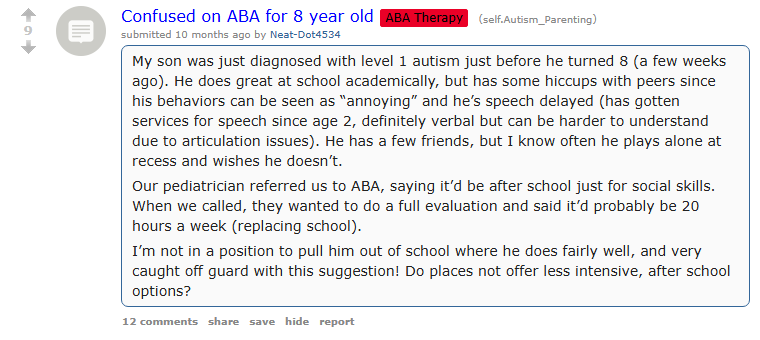
School-related problems ABA may address
Most school-age referrals trace back to a handful of pressure points. ABA can target each one directly:
- School refusal and difficult morning routines
- Classroom transitions and shifting between activities
- Homework refusal and after-school meltdowns
- Peer conflict and asking for a break the right way
- School-to-home transitions that go sideways
Where therapy can happen
School-age ABA does not have to live in one place. Depending on clinical need and what your child's school allows, the plan can run through:
- In-home ABA therapy
- After-school ABA for homework and evenings
- BCBA school consultation
- ABA therapy in school (direct school-based ABA) when the district approves it
- Community practice when it is clinically appropriate
How goals may change between ages 6 and 12
These are examples of how a plan grows with a child, not promises. Every plan is individualized.
| Age | Possible focus |
|---|---|
| Age 6 | Classroom routines, requesting help, transitions, toileting, simple household routines |
| Age 8 | Homework, peer play, coping with changes, following multi-step directions |
| Age 10 | Independence, problem solving, communication during conflict, community safety |
| Age 12 | Self-advocacy, personal care, household responsibility, preparing for adolescence |
ABA therapy for school-age children in Denver
Budding Futures serves school-age children across the Denver metro and Colorado, and the in-home model means the BCBA sees the real routines that go wrong, from the morning rush to the homework hour. Denver families can read more on our ABA therapy in Denver page, and our Clinical Director, Rachel Blackburn, BCBA, reviews each plan. Read more about when autism and ADHD occur together.
How to begin
- Tell us what is happening at school, after school, and at home.
- We review service fit and verify your insurance or Health First Colorado coverage.
- A BCBA completes an assessment and builds the plan around your child's stage.
Frequently asked questions
Is my child too old for ABA?
Is ABA only for toddlers?
Can ABA help with school refusal?
Can ABA help with homework refusal?
Can sessions happen after school?
Can a BCBA communicate with my child's teacher?
Does Medicaid cover ABA for school-age children?
How many hours of ABA might my child need?
How soon can we begin?
You do not need to wait until the problem gets worse
Tell us what is happening at school, after school, or at home. We will help you understand whether ABA may fit your child's current needs and what the next step would be.
Request an Intake Call →Sources
CDC, Autism Prevalence (ADDM, 2022) · Health First Colorado, EPSDT children's benefits · Peer-reviewed reviews of ABA outcomes

ABA Therapy by Age and Condition
Where Can Your Child Get ABA Therapy in Colorado?
Budding Futures offers ABA therapy for school-age kids in the family home in each of these cities and across the rest of Colorado. See every Colorado city we serve or browse all of our ABA therapy services.
Just started school, or about to? See moving from in-home ABA to school support.
Your family deserves a team that puts you first
One conversation. That's all it takes to find out if Budding Futures is the right fit. We'll answer your questions, check your insurance, and connect you with a BCBA who'll get to know your family.
What ABA works on at each age from 6 to 12
Every plan is individualized, but these are the goals parents most often bring us at each age.
First grade asks a lot: multi-step directions, sitting for instruction, mornings that start on time. Plans at six usually target those routines.
Friendship skills take center stage. We work on losing games gracefully and sticking with schoolwork that suddenly got harder.
Eight-year-olds want independence. Therapy builds self-care, flexible thinking when plans change, and playdates that end well.
Emotions get bigger around nine. Goals often focus on self-regulation, group work at school, and homework without a nightly battle.
Organizing tasks, keeping track of belongings, safer outings in the community, more independence at home.
We prep for middle school here: self-advocacy, busier schedules, and friendships that keep shifting.
Puberty changes the picture. Plans shift toward staying regulated through longer days and building real independence.
Prefer to listen? Our parent podcast episode on ABA for school-age children covers the after-school crash, homework breakdowns, and evening sessions.