
The ABA Workforce Report 2026
The person who spends the most hours with your child in ABA therapy is usually not the one with the graduate degree. That has always been true. What has changed is the ratio.
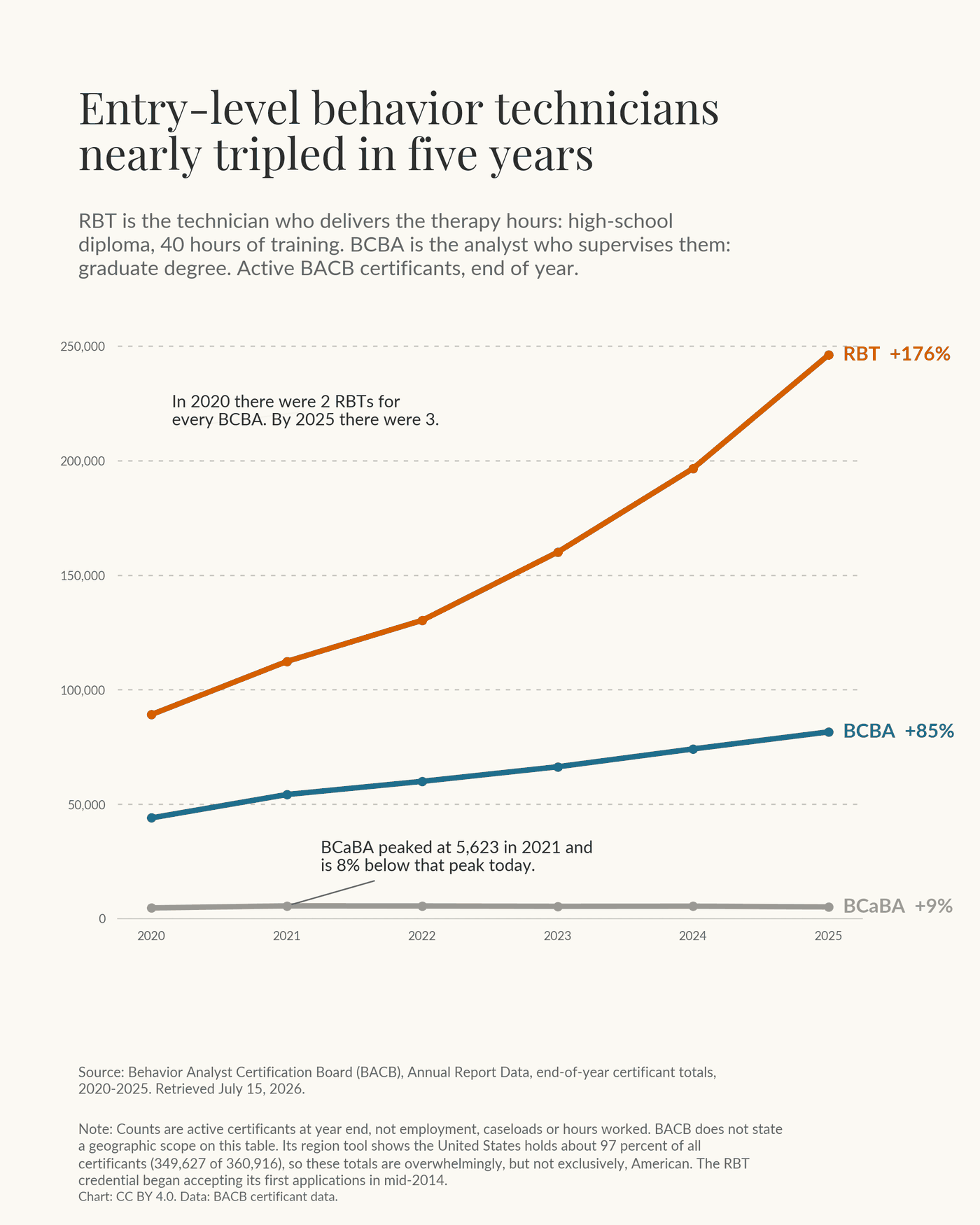
We pulled the Behavior Analyst Certification Board's own certificant tables for 2020 through 2025. Entry-level behavior technicians nearly tripled. The analysts who supervise them did not grow nearly as fast, and the credential in between them barely moved at all.

There were 2 behavior technicians for every supervising analyst in 2020. By 2025 there were 3.
What we found
Applied behavior analysis has three practitioner credentials. They are not the same job, and the gap between them is wide.
A Registered Behavior Technician, or RBT, needs a high school diploma, a 40 hour training course, a competency assessment, and a background check. A Board Certified Behavior Analyst, or BCBA, holds a graduate degree and writes and supervises the treatment plan. The BCaBA sits in the middle.
Between 2020 and 2025, RBT certificants grew 176 percent. BCBAs grew 85 percent. BCaBAs grew 9 percent, and are actually 8 percent below their 2021 peak. The field is growing, and it is growing fastest at the entry level.
The three credentials, side by side
If you are a parent comparing providers, this table is the part worth keeping.
| Credential | What it requires | What the person does | Change, 2020 to 2025 |
|---|---|---|---|
| RBT Registered Behavior Technician | High school diploma, 40 hour training, competency assessment, background check, age 18 or older | Delivers the therapy hours directly with your child | 89,122 to 246,109 +176% |
| BCaBA Board Certified Assistant Behavior Analyst | Bachelor's level coursework plus supervised fieldwork | Assists the supervising analyst | 4,729 to 5,171 +9% |
| BCBA Board Certified Behavior Analyst | Graduate degree plus supervised fieldwork and a board exam | Assesses your child, writes the plan, supervises the RBT | 44,025 to 81,566 +85% |
None of this makes an RBT a bad thing. Good RBTs are the backbone of good therapy, and many are excellent at what they do. The question this data raises is not whether technicians should exist. It is how closely they are supervised.
Why the supervision ratio matters
The BCBA is the person who decides what your child works on, watches how it is going, and changes the plan when it is not working. The RBT is the person in your living room running it.
When the number of technicians grows three times faster than the number of analysts, each analyst has more people and more children to keep an eye on. That does not automatically mean worse care. It does mean supervision is the thing to ask about.
The BACB sets a minimum of 5 percent supervision of an RBT's service hours. That is a floor, not a target. A provider who treats the floor as the goal is telling you something.
Four questions worth asking any ABA provider
| Ask this | Listen for this |
|---|---|
| What percentage of my child's hours does a BCBA supervise? | A real number, and one comfortably above the 5 percent minimum. |
| Will my child have the same RBT each week? | A plan for consistency, not a rotating roster of new faces. |
| How many children does the supervising BCBA carry? | A caseload the provider is willing to say out loud. |
| Who do I call when something is not working? | A named BCBA who knows your child, not a general inbox. |
How Budding Futures handles this
We are an ABA provider, so we will be direct about where we stand on the number in this report.
Our BCBA supervision target sits around 20 percent when clinically appropriate, well above the BACB minimum of 5 percent. Rachel Blackburn, BCBA, our clinical director, oversees the plans. We keep caseloads intentionally lower so that supervision is real rather than nominal, we work to keep the same therapist with the same child, and our RBTs complete enhanced background checks and fingerprinting on top of the standard requirements.
We deliver ABA in the home, across Colorado, and we accept Health First Colorado along with private insurance. You can read the full detail, including our credentialing and our supervision approach, on our quality and credentials page, or see how BCBA supervision works day to day.
If you are still comparing providers, our guide to choosing an ABA provider in Colorado walks through what to look for, and our Colorado ABA Waitlist Report explains why the wait happens in the first place.
How we did this, and what it does not show
We took the end of year certificant totals that the BACB publishes for each of its three practitioner credentials and plotted them on one axis, 2020 through 2025. The percentages are simple change from the 2020 value to the 2025 value. The ratio is straight division. Nothing is smoothed or modelled, and the underlying numbers are in the chart.
Four limits are worth stating plainly, because they matter.
- These are credentials, not jobs. The tables count people who hold a certification. They do not count who is working, how many hours they deliver, or how many children they serve.
- The BACB does not label the geography. We did not stamp "United States" on data that does not say so. The BACB's own region tool shows the US holds 349,627 of 360,916 certificants, about 97 percent, so the totals are overwhelmingly but not exclusively American.
- The series starts in 2020 because that is where the published table starts. It is not a chosen starting point. The RBT credential only began accepting applications in mid 2014, so a longer view would be steeper, not flatter.
- A growth gap is not proof of harm. RBT and BCBA are different roles, not rival tiers of one job. What the data supports is narrow and specific: the ratio of technicians to supervising analysts moved from about 2 to 1 up to about 3 to 1.
This report makes no claim about whether ABA works. It describes a workforce.
Sources
BACB annual report data
End of year certificant totals for RBT, BCBA and BCaBA, 2020 to 2025. This is the source for every plotted point.
BACB certificant data
Current counts and the region by region breakdown used for the geographic note.
BACB RBT requirements
The eligibility standards for the RBT credential, including the 40 hour training and competency assessment.
Common questions
What is an RBT?
A Registered Behavior Technician is the entry level credential in applied behavior analysis. It requires a high school diploma, a 40 hour training course, a competency assessment, a background check, and a minimum age of 18. RBTs deliver most of the direct therapy hours with a child, working from a plan written by a supervising BCBA.
Is an RBT the same as a BCBA?
No. A BCBA holds a graduate degree, completes supervised fieldwork, and passes a board exam. The BCBA assesses your child, writes the treatment plan, and supervises the RBT who carries it out. They are two different roles with very different training requirements.
How much BCBA supervision should my child's therapy get?
The BACB sets a minimum of 5 percent of an RBT's service hours. That is a floor, not a recommendation. At Budding Futures our supervision target sits around 20 percent when clinically appropriate. Ask any provider for their actual number, and be cautious if they cannot give you one.
Does a fast growing technician workforce mean therapy is getting worse?
The data does not show that, and we will not claim it. It shows that the ratio of technicians to supervising analysts moved from about 2 to 1 in 2020 to about 3 to 1 in 2025. Whether that affects care in any individual case depends on how closely that provider actually supervises. That is why supervision is the question to ask.
Who should I call in Colorado if I want in-home ABA?
Budding Futures ABA provides in-home ABA therapy across Colorado, led by Rachel Blackburn, BCBA. We accept Health First Colorado and private insurance, and we can walk you through coverage before you commit to anything. Call (720) 613-8837 or use the contact form on our site.
More original research from Budding Futures
See the full set on our autism and ABA research page, or read one of these next.
Want to know who will actually be in the room with your child?
We will tell you who supervises the plan, how often, and what your insurance covers. No waitlist right now.