
Rachel Blackburn, BCBA
Clinical Director
Board Certified Behavior Analyst · Master's in Applied Behavior Analysis
She supervises the therapists who work in your home.
Read Rachel's profileBudding Futures teaches children with autism to get dressed, brush teeth and wash, in their own bathroom and bedroom anywhere in Colorado. A BCBA writes the plan and coaches you. No waitlist.
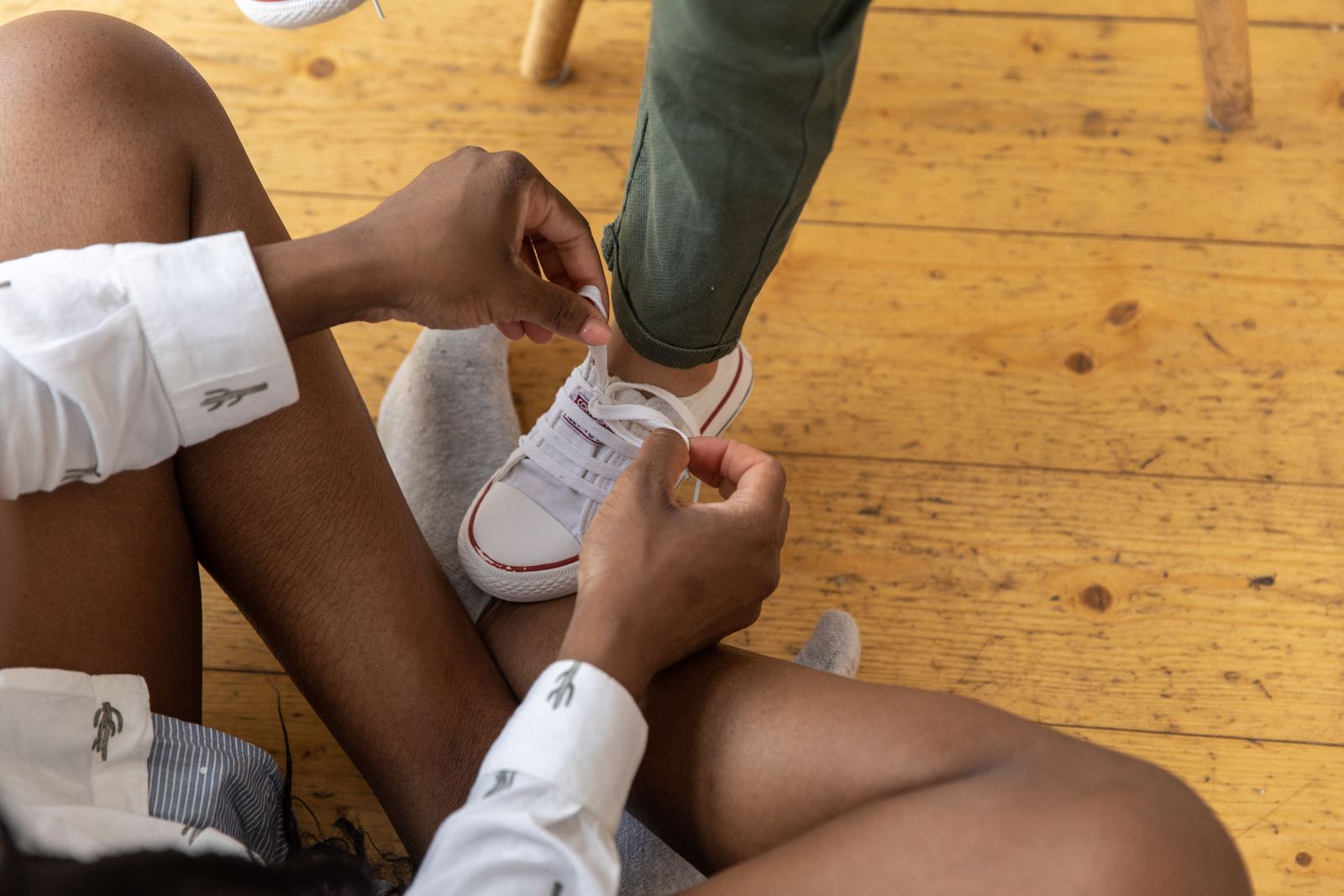
Yes, ABA therapy teaches daily living skills. Each self-care task is split into small steps, and your child learns one step at a time, at the sink and in the bedroom where the skill is used.
| Skills ABA can teach | Getting dressed, brushing teeth, washing hands and face, bathing, daily routines. |
|---|---|
| How | Task analysis: one small step at a time, with positive reinforcement (praise or a reward) after each try. |
| Where | Your own bathroom and bedroom, anywhere in Colorado. |
| Who | A BCBA writes the plan and visits in person. The same technician comes each week. |
| Your part | Parent coaching, so the routine works on the days we are not there. |
| Ages and wait | 18 months to 18. No waitlist. |
| Cost | Health First Colorado (Medicaid): usually $0. Other insurance: we check your plan first. |
The method is called task analysis: “A process in which an activity or behavior is divided into small, manageable steps in order to assess and teach the skill” (NCAEP review).
Often the therapist teaches the last step first, so your child finishes the job every time. “The final step in a chain is taught first. As each step is mastered, the previous step is taught” (AFIRM, University of North Carolina).
| 1 | Turn on the water |
|---|---|
| 2 | Pick up the toothbrush |
| 3 | Wet the toothbrush |
| 4 | Put toothpaste on |
| 5 | Brush the top teeth |
| 6 | Brush the bottom teeth |
| 7 | Brush the left side |
| 8 | Brush the right side |
| 9 | Rinse the mouth |
| 10 | Spit |
| 11 | Turn off the water |
| 12 | Dry hands and mouth |
In that small study of eight children, “33.7% of the steps were achieved by children at baseline and 77.5% at post-training” (Children, 2024). Results differ for every child.
Hygiene tasks touch the most sensitive places: the mouth, the scalp, the face. The National Institute of Dental and Craniofacial Research says of some autistic children: “Some are defensive and refuse any contact in or around the mouth, or cradling of the head or face” (NIDCR).
In a survey of parents, children who were “sensory over-responders” had “a significantly greater prevalence of oral care difficulty in the home and dental office” (Stein and colleagues, 2013).
So a plan starts with a step your child accepts and builds from there. Your child is not forced.
Show, then do it together. In a 2026 trial of 60 children, “Caregiver modeling was the most effective method for teaching toothbrushing to children with ASD” (Special Care in Dentistry). It beat posters and video.
That is why parent coaching matters. Your child brushes twice a day with you, not with a therapist.
Dressing uses the same chain. For example, your child does the last step first: pulling the shirt down. Then arms in, then head through. Each new step is added when the one after it is easy.
A set order, the same every morning, can help your child learn the routine.
Haircuts are the daily living skill parents search for most. “The head is particularly sensitive to touch, which can make hair washing, brushing, or cutting an uncomfortable and sometimes distressing experience” (University Hospitals Dorset NHS).
It can be taught in small steps toward the clippers, but it is slow. In one study, two participants sat through a full haircut “following approximately 200 sessions each, and spanning many months” (ASAT). Ask your BCBA whether a haircut goal fits your child’s plan.
Two tips from the same NHS leaflet:
Monthly U.S. searches, read November 16, 2026.
A skill learned at a clinic sink has to be learned again at yours. In-home therapy sessions skip that step.
Written instructions are not enough for parents and caregivers either. In one study, “Parents did not correctly implement graduated guidance after receiving detailed written instructions only.” After live coaching, “all children completed the targeted self-care skills with substantially higher levels of accuracy and independence” (Journal of Applied Behavior Analysis, 2020).
Budding Futures provides in-home ABA therapy across Colorado for children 18 months to 18.
Daily living skills are one of the behaviors and skills ABA therapy works on.
The experts, studies and organizations quoted are outside sources. They are not affiliated with Budding Futures and did not review this page. This is general information, not advice for your child.
They are the self-care tasks of an ordinary day: getting dressed, brushing teeth, washing, bathing, hair care and following a routine. You may also see them called life skills or activities of daily living (ADLs).
Pick one task. Write down its steps. Teach one step at a time, help less each day, and praise every try. Keep the routine in the same order. Your BCBA coaches you on the steps the technician uses.
No. Occupational therapy works on sensory needs and motor skills. ABA therapy teaches the routine step by step. Budding Futures provides ABA and coordinates with your child's occupational therapist.
Yes. Both are taught the same way, and each has its own page on this site.
Self-care goals are part of a medically necessary ABA plan. Health First Colorado usually covers it at $0. For other plans, we check your benefits before you start.
She supervises the therapists who work in your home.
Read Rachel's profile
He founded Budding Futures and runs the day to day, from a family's first phone call onward.
Read Mark's profileBudding Futures offers ABA for daily living skills in the family home in each of these cities and across the rest of Colorado. See every Colorado city we serve or browse all of our ABA therapy services.
Emotional regulation · Social skills · Self-injury and head banging · Picky eating and feeding · Tantrums and meltdowns · Aggression · Potty training · Sleep
At Budding Futures ABA, your child's BCBA does more than oversee therapy.
Request a free consultationIn-home and school-based ABA across Colorado, ages 18 months to 18.
Tell us which routine is hardest in your house. We will explain what a plan would start with.