
Autism poop withholding: why your child pees on the potty but won't poop there
Many autistic kids who pee on the potty hold their poop because a poop once hurt, or because pooping is a lot for the senses. Holding it makes the next poop harder, so the loop keeps going.
Talk to your pediatrician first. Budding Futures ABA helps Colorado families with potty training at home.
healthy toddlers in a study of 482 refused to poop on the toilet for a month or more. Constipation is also more common in autistic children.
- Peeing and pooping are different skills. One painful poop can start withholding.
- Pooping "heavily engages the senses," so autistic kids may hold it more (Children's Hospital Colorado).
- Constipation is common in autism: a median of 22% across 144 studies.
- Soft stools first. Then short sits after meals, feet on a stool, rewards for poop in the potty.
- Call the doctor for blood, vomiting, a swollen belly, weight loss or pain over an hour.
Published October 17, 2026 by the Budding Futures team. Updated October 18, 2026. The doctors and researchers quoted are outside sources, not affiliated with Budding Futures. General education, not medical advice.
Why your autistic child pees on the potty but won't poop
Usually because a poop hurt once, or because pooping is a lot for the senses.
Peeing and pooping are two different skills. Bowel and bladder control don't always arrive together.
Urination is quick and easy to feel. Pooping takes longer, can hurt, and means relaxing on a seat that may feel tall, loud and strange.
The pain loop
One hard poop can teach a child that pooping hurts. So they start to withhold stool.
Holding it causes stool to build up, so the next poop is bigger and harder. That one hurts more, and the loop keeps going.
One painful bowel movement may be all it takes to cause children to associate pain with passing stool, so they start withholding it instead,

Why autism can make it harder
Children's Hospital Colorado says constipation is more likely in kids who have autism.
Many eat a short list of foods. And pooping "heavily engages the senses," which can be distressing.
Other reasons a child holds poop
- Control. Kids aged 2 to 5 like to decide things for themselves. Holding poop can be one of them.
- The toilet itself. Its size, sounds and location can feel like too much.
- Missing the signal. Some kids don't feel the urge to defecate until it's urgent.
- Sameness. A child used to pooping standing up, in a diaper, in one spot, may resist any change.
Read more: what the doctors say, word for word
Children's Hospital Colorado: constipation "is more likely in kids who have autism. Oftentimes, their diets are limited due to selectivity and sensory challenges. And because pooping heavily engages the senses and could cause some children with autism distress, they are more likely to hold it in." Its gastroenterologist, Christine Waasdorp Hurtado, MD, adds: "And once they've had a painful poop, it often triggers withholding."
The AAP: "Children aged 2 to 5 years may want to show they can decide things for themselves. Holding back their stools may be their way of taking control." It also describes "a lack of awareness of the body's signs for needing to poop." (AAP)
Dr. Goldman on the toilet: its "size, sounds and location" can "sometimes be overwhelming for a toddler."
Signs your child is withholding poop
Withholding can look like dancing, hiding or stubbornness.
- Standing on tiptoes, rocking, or crossing their legs.
- Asking for a diaper or pull-up only when it's time to poop.
- Hiding behind furniture or in a corner to poop.
- Long gaps between poops, then a large stool that's hard to pass.
- Streaks or small leaks in the underwear.
- More meltdowns or tantrums, poor sleep or a lack of appetite after a few days without pooping.
Constipation symptoms in children are easy to miss. A child may withhold for days and still seem fine at first.
Leaks aren't a step backward
Around a big, hard stool, runny poop can leak out. It can look like diarrhea.
Doctors call this encopresis, a kind of stool incontinence. It's not a choice, and it's not a training failure (AAP).
Behavior can be the only clue
Some kids can't tell you their tummy hurts.
Experts say problem behavior may be the main sign of a gut problem in autistic kids.
Read more: the signs, in the sources' own words
The NIDDK lists "standing on tiptoes and then rocking back on his or her heels," "clenching his or her buttocks" and "doing unusual, dancelike movements" (NIDDK). Children's Hospital Colorado adds: "They may start to cross their legs, rock and twist to keep from passing poop."
Dr. Goldman: "liquid stool can leak around it and stain their underwear." The AAP: "When poop overflows like diarrhea because of constipation, we call this encopresis."
An expert panel wrote: "Care providers should be aware that problem behavior in patients with ASDs may be the primary or sole symptom of the underlying medical condition, including some gastrointestinal disorders" (Buie and colleagues, Pediatrics, 2010).
How common are stool withholding, constipation and other gastrointestinal (GI) problems in autism?
Very common, in all toddlers and even more so in autistic kids.
In a study of 482 healthy toddlers, about one in five refused to poop on the toilet for a month or more.
Constipation, which often drives withholding, is the most common of the gastrointestinal issues in autistic children.

What happens in the bowel
Poop that stays in keeps losing water. So it gets harder and bigger.
If it keeps building, it can form a blockage. Doctors call that an impaction.
That's why the doctor treats the gut side first. Ask how long treatment should run before you judge it.
You may read that autistic kids are "3.8 times more likely" to be constipated. That misreads the study. The honest version: constipation is clearly more common in autistic children, and how much more depends on the study.
Read more: the studies, with their limits
| What was measured | Finding | Source and limits |
|---|---|---|
| Toddlers who refused to poop on the toilet for a month or more | 22% (106 of 482) | Taubman, 1997. Healthy children, one suburban practice. |
| Children worldwide with functional constipation | 9.5% pooled (range 0.5% to 32.2%) | Koppen, 2018. 37 population studies. |
| Constipation in autistic children and adults | Median 22% (range 4.3% to 45.5%) | Holingue, 2018. 144 studies, very different methods. |
| Odds of constipation, autistic vs other children | Odds ratio 3.86 | McElhanon, 2014. 15 studies with comparison groups. |
| Odds of constipation in nonverbal autistic children | Odds ratio 11.98 (range 2.54 to 56.57) | Gorrindo, 2012. 121 children, very wide range. |
In the Gorrindo clinic study, "Functional constipation was the most common type of GID in children with ASD (85.0%)." GID means gastrointestinal dysfunction: problems anywhere in the digestive tract.
The AAP says encopresis "can look like diarrhea caused by infections. However, it is actually the child's body attempting to evacuate a large amount of poop."
When to call the pediatrician about poop withholding
Start with your pediatrician. Hard stools need softening before potty steps can work.
Go now, or call today
- Go to the ER for green vomit.
- Get care now for belly or bottom pain that lasts over an hour, or vomiting with a swollen belly.
- See a doctor right away for blood, bloating, constant belly pain, vomiting or weight loss with constipation.
- Call within 24 hours if your child needs to poop but is afraid to let it out.
Call soon
- Symptoms last more than 2 weeks.
- Your child is still stuck on the potty after two or three months.
The AAP counts 3 or more days without a poop as part of its definition of constipation. When in doubt, call.
What the doctor may do
Constipation treatment is medical. Don't give a laxative unless your doctor says to.
The doctor may prescribe medicine for a while, then help you step it down.
Treating chronic constipation takes time. The AAP says maintenance medicine for at least 2 months.
Pause potty training, or keep going?
The sources disagree. The NIDDK says take a break until the constipation stops. The AAP says keep going while it's treated.
Ask your pediatrician which fits your child.
Read more: the red flags and treatment, word for word
| Sign | What the source says | Source |
|---|---|---|
| Green vomit | "Go to ER Now Vomiting bile (green color)." | AAP KidsDoc |
| Pain over an hour | "Stomach pain goes on more than 1 hour (includes crying) after using care advice" and "Rectal pain goes on more than 1 hour (includes straining)" | AAP KidsDoc |
| Swollen belly with vomiting | "Vomits 2 or more times and stomach looks more swollen than normal" | AAP KidsDoc |
| Blood, bloating, pain, vomiting, weight loss | "Take your child to a doctor right away if he or she has constipation and any of the following symptoms" | NIDDK |
| Afraid to let it out | "Needs to pass a stool but afraid to or refuses to let it out" (call within 24 hours) | AAP KidsDoc |
| More than 2 weeks | "Your child should see a doctor if his or her symptoms last for more than 2 weeks or do not go away with at-home treatment." | NIDDK |
| Two weeks, swollen belly, not eating | "it may be time to go to the emergency room" | Children's Hospital Colorado |
| Stuck after months | "Your child is still having trouble pooping on the potty after two or three months." | Cleveland Clinic |
The NIDDK: "You should not give a child a laxative unless told to do so by a doctor." Doctors "may recommend giving your child an enema or laxative." (NIDDK)
The AAP: "discuss any treatments with your child's doctor before starting." "Constipation should be treated with maintenance medications for at least 2 months." "PEG 3350 does not cause autism spectrum disorders." (AAP)
On pausing: the NIDDK says "Take a break from potty training until the constipation stops." The AAP says your child "should CONTINUE toilet training and take their medicines until toilet training is completed and they have been free of symptoms for one additional month." For a child who is not ready, "waiting until the child matures is the sensible choice" (American Family Physician, 1999).
What helps a child poop on the potty: steps from published sources
Once stools are soft, go in small, calm steps. No force.
These practical tips come from doctors and autism toilet-training guides. The aim is regular bowel movements and a regular routine your child can predict.
- Soft stools first. Every step below works better once pooping doesn't hurt.
- Change diapers in the bathroom. It helps your child link poop with the bathroom (University of New Mexico). Many families then let the child poop in a diaper in the bathroom before trying the toilet.
- Feet flat, body steady. Put a step stool in every bathroom so the seat feels secure.
- Sit after meals. Plan bathroom visits 5 to 20 minutes after each meal. A few minutes is enough.
- Make it calm. Blowing on a pinwheel helps relax the pelvic floor. Books, a favorite toy and your attention help too.
- Reward the poop, not dry pants. This is positive reinforcement. Praise or a small reward works best right after the poop lands in the potty.
- No long, forced sits. Forcing a child to sit makes it negative, and they may hold it more.
Nationwide Children's Hospital: poop withholding, and how to sit so poop comes out easier (2 min)
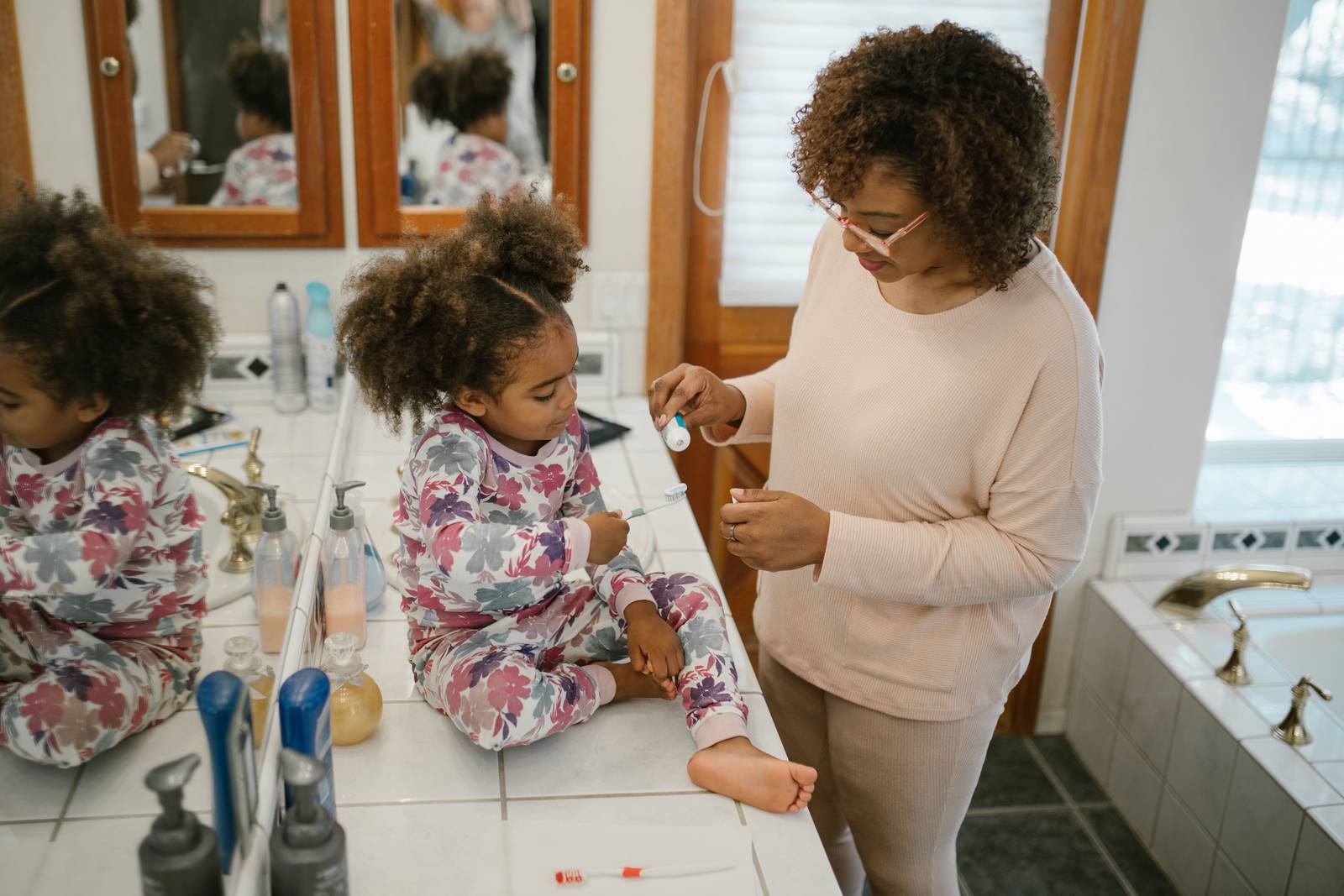
An honest limit: most autism toilet-training research is about peeing, not pooping. We found no study of the diaper-in-the-bathroom steps for poop in autistic kids. They're common practice, not proven.
Read more: where each step comes from
American Family Physician: "It is critical to ensure that the child is having relatively frequent, soft and well-formed bowel movements before engaging in any intervention for soiling." "The best time to schedule prompted sits is five to 20 minutes after each meal," and "These sits can be scheduled up to five times daily for three to five minutes each." "Incentives can instead be tied to the passage of fecal material in the toilet." (AAFP, 1999)
University of New Mexico: "Begin changing your child's diapers in the bathroom. This can help your child associate the process with the bathroom." (source)
Dr. Goldman recommends "a step stool in every bathroom." Children's Hospital Colorado suggests about one minute of sitting per year of age, up to 10 minutes, says a pinwheel "relaxes the pelvic floor," and adds: "Try not to force your kid to sit on the toilet for a long period of time. This makes the experience negative, which can make them withhold more."
A University of Rochester guide says of the gentle child-led approach that "there is little research to indicate that it is effective for children with autism" (URMC).
If your child is nonspeaking
Watch behavior. It's often how pain shows up.
A child who can't say "my tummy hurts" may hit, cry or refuse to sit.
One clinic study linked constipation strongly with not speaking.
- Watch for new or worse behavior around meals, sitting or bedtime.
- Keep a simple log: date, poop or no poop, how it looked, how your child acted. It makes irregular bowel movements easy to spot. Bring it to the pediatrician.
- Give your child a way to say they need to use the bathroom: a picture card, a sign or a button on their device.
- Use the same word every time, whether your family says poop, poo or number two.
- Show the steps with pictures: bathroom, pants down, sit, poop, wipe, flush, wash.
Read more: the research on nonspeaking kids
"A central difficulty in recognizing and characterizing gastrointestinal dysfunction with ASDs is the communication difficulties experienced by many affected individuals" (Buie and colleagues).
In a clinic study of 121 children, the odds of constipation in nonverbal children were 11.98, with a very wide range of 2.54 to 56.57, so read it as "linked," not "caused" (Gorrindo, 2012).
Where ABA potty training fits, and where it doesn't
ABA doesn't treat constipation. It helps with the behavior side once stools are soft.
That means fear of the toilet, a stuck routine, and learning each step of pooping on the potty.
We coach parents of kids who are ready to use the toilet but still hold their poop.
In ABA potty training, a BCBA works out what's blocking your child.
Then we break pooping on the potty into small steps and coach you through each one, gently and without force.
At home, across Colorado
Sessions happen in your own bathroom with in-home ABA therapy across Colorado.
In the Denver area, see autism potty training in Denver. With Health First Colorado (Medicaid), families usually pay nothing.
Questions parents ask about poop withholding
Why will my autistic child pee on the potty but not poop?
How long is too long for a child to hold poop?
Should I stop potty training if my child is withholding?
Is poop withholding a sign of autism?
Can I give my child a stool softener or laxative?
Can ABA therapy help with poop withholding?
Sources
- Cleveland Clinic. Tricks To Get Your Toddler to Poop on the Potty. Deborah Goldman, MD, July 14, 2022.
- Children's Hospital Colorado. Constipation Relief in Kids. Christine Waasdorp Hurtado, MD.
- American Academy of Pediatrics, HealthyChildren.org. Constipation in Children, last updated July 10, 2024, and the KidsDoc symptom checker: Constipation.
- National Institute of Diabetes and Digestive and Kidney Diseases. Constipation in Children.
- Kuhn BR, Marcus BA, Pitner SL. Treatment Guidelines for Primary Nonretentive Encopresis and Stool Toileting Refusal. American Family Physician, 1999.
- Buie T and colleagues. Evaluation, diagnosis, and treatment of gastrointestinal disorders in individuals with ASDs: a consensus report. Pediatrics, 2010.
- Taubman B. Toilet training and toileting refusal for stool only: a prospective study. Pediatrics, 1997.
- McElhanon BO and colleagues. Gastrointestinal symptoms in autism spectrum disorder: a meta-analysis. Pediatrics, 2014. Holingue C and colleagues. Gastrointestinal symptoms in autism spectrum disorder: a review of the literature on ascertainment and prevalence. Autism Research, 2018.
- Gorrindo P and colleagues. Gastrointestinal dysfunction in autism: parental report, clinical evaluation, and associated factors. Autism Research, 2012. Koppen IJN and colleagues. Prevalence of Functional Defecation Disorders in Children: A Systematic Review and Meta-Analysis. Journal of Pediatrics, 2018.
- University of Rochester Medical Center. Toilet training handout, 2010. University of New Mexico Center for Development and Disability. Getting Ready for Toilet Training.
- Nationwide Children's Hospital. "Constipation in Kids | Poop Withholding and What To Do When Kids Won't Poop!" (video), 2023.
Potty training stuck on poop?
Tell us where things stand. We'll explain how in-home ABA potty training works. If a pediatrician visit should come first, we'll say so.
- Every plan is written and supervised by a BCBA
- No waitlist, and we verify your benefits free before anything starts
- Health First Colorado (Medicaid)
- Aetna
- Cigna
- UnitedHealthcare
- Anthem BCBS
- TRICARE