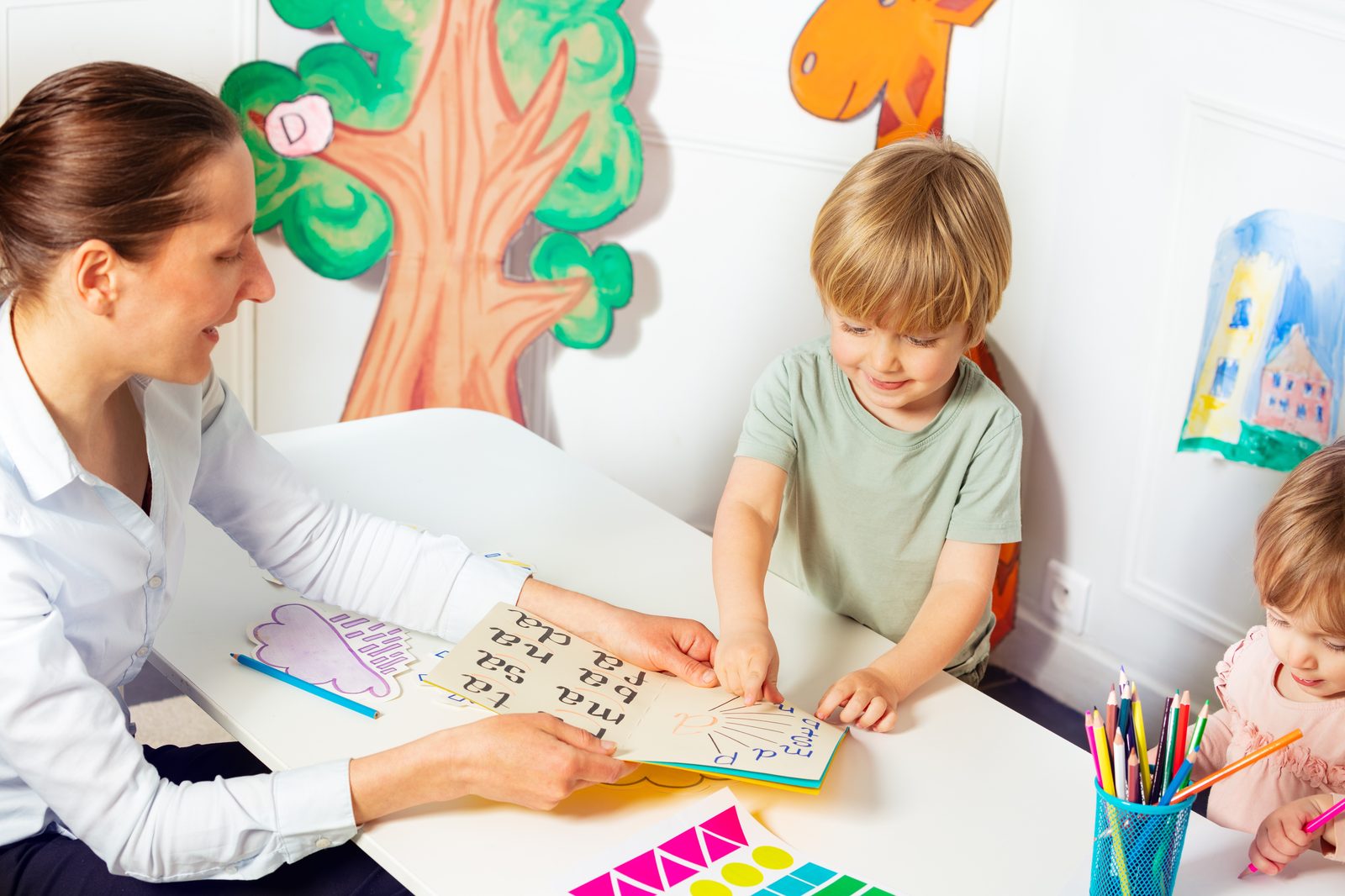
Can ABA Help an Autistic Child With a Speech Delay?
Yes, as part of autism treatment, ABA therapy can support functional communication. It does not replace a speech-language pathologist's assessment or treatment of articulation, language, fluency, voice, or feeding. ABA also helps children with a language delay build the communication skills they use every day.
Budding Futures uses verbal behavior techniques, part of applied behavior analysis and rooted in B.F. Skinner's analysis of language, to build communication skills that work. Mand training teaches your child to request what they want. Tact training builds labeling and early language skills. Every goal targets real-world function and uses positive reinforcement, not rote repetition. For a child experiencing speech delays, the aim is to communicate effectively today while speech and language development continues.
Speech and Communication Are Not the Same Thing
Speech is one mode of communication. A child can have words and still not use them functionally, and a child with no words can still communicate well.
Communication includes requesting, refusing, commenting, answering, initiating, social interaction, and self-advocacy. A child may have single words but no way to combine them, or strong language skills with weak social use. Those communication skills are the difference that matters for daily life, and they are where communication-focused ABA puts its attention.
ABA Therapy vs Speech Therapy
Parents often ask whether ABA or speech therapy is the right choice. They do different jobs, and for many children the answer is both.
| Speech-language therapy (SLP) | Communication-focused ABA |
|---|
| Main focus | Assess and treat speech and language: articulation, vocabulary, sentence structure, fluency, feeding. | Functional use of communication across routines, plus reducing behavior tied to not being understood. |
|---|
| Typical methods | Language drills, articulation practice, modeling, oral-motor work. | Verbal behavior, mand and tact training, PECS, AAC, natural environment teaching. |
|---|
| Where | Often clinic or school based. | In your home and your child's real routines. |
|---|
| Best when | Speech sound or language structure is the core need. | Your child needs a reliable way to request, refuse, and connect now. |
|---|
Read the full comparison of ABA and speech therapy for more detail.
Can ABA and Speech Therapy Work Together?
Yes, and they usually should. The two are complementary, not competing, and coordinated care prevents conflicting prompts.
With your consent, your BCBA shares goals with your child's speech-language pathologist, or speech therapist, so both providers reinforce the same communication system. The ABA therapist and the speech therapist work toward speech and language skills together instead of against each other. Budding Futures also runs a school collaboration program so the strategies carry into the classroom.
What Communication-Focused ABA Looks Like at Home
Communication is taught where it actually happens, in the kitchen, at dressing time, during sibling play, and on the way out the door. Natural environment teaching embeds practice into the day instead of a table drill. Families can read about communication-focused ABA services in Fort Collins and home-based ABA in Aurora.
An in-home session looks like this: the therapist notices what your child is trying to communicate, helps them use an efficient response, honors appropriate refusal, reinforces spontaneous communication, then fades prompts. Starting ABA early matters here, because early intervention helps children build communication before frustration sets in. Our parent coaching teaches you to help your child use the same opportunities all day, since that is where communication generalizes.
Words, Signs, Pictures, PECS, and AAC
No single communication mode is better than another. The right one is whatever gives your child the fastest, most reliable voice.
A common fear is that an AAC device will stop a child from talking. The research says the opposite. Across 27 studies, 89% of children using AAC spoke the same or more, and not one study showed a decrease. AAC is for far more than requesting snacks; it should cover help, refusal, discomfort, questions, comments, and feelings, and it is never removed as punishment.
ABA for a Nonverbal Child
A nonverbal child is not a child with nothing to say. ABA starts with whatever communication system gives them the quickest access to expressing needs, then builds from there.
For children who are fully nonverbal, we often lead with functional communication training, teaching a clear request that replaces frustration. Our Clinical Director Rachel Blackburn, BCBA, brings a background in American Sign Language, which she integrates into communication programming when it fits the child.
What About Echolalia?
Repeated or scripted language is often meaningful and should not be automatically suppressed. Echolalia can be a child's way of holding a turn, requesting, or self-regulating. More on that: autism scripting, and what to say back. If your child had words and lost them, read autism speech regression.
We work to understand what the repeated language is doing, then shape it toward flexible communication, involving the speech-language pathologist where appropriate.
How Communication Reduces Meltdowns
Many meltdowns are a communication problem in disguise. When a child cannot ask for help, a break, or a different choice, that need often comes out as hitting, throwing, or leaving.
Teaching a reliable request changes that. Functional communication training shows a large effect in the research on reducing aggression and self-injury, because the child finally has a faster, safer way to be heard.
What Communication Progress Looks Like
Progress is measured in function, not just word count, though speech development and language skills often grow alongside it. Early intervention helps, including for a child whose only sign is a developmental delay: in one study of 535 children, 70% reached short-phrase speech and 47% reached fluent speech with appropriate therapy.
More spontaneous requests and initiations
Fewer and lighter prompts needed
More reasons to communicate, not just wants
Communicating with more people
Asking for help or a break instead of melting down
Using communication outside of therapy
Your BCBA tracks this data weekly and adjusts the plan as your child's language grows. See how we measure progress.
Does Medicaid or Insurance Cover Communication ABA?
Coverage generally depends on autism-related medical necessity and the full treatment plan, not a speech delay by itself. When communication goals are part of medically necessary ABA, they are typically covered like any other goal.
| Path | Typical family cost | Notes |
|---|
| Health First Colorado (Medicaid) | Usually $0 | Covered when eligible, subject to prior authorization and medical necessity. |
|---|
| Commercial insurance | $0 to $1,000 | Depends on your deductible, copay, and plan. Verified up front. |
|---|
| Private pay | About $2,000 to $8,000 | A range that depends on recommended weekly hours and service mix. |
|---|
These are examples, not a quote. Budding Futures verifies your benefits before treatment. See how Health First Colorado covers ABA.
Communication-Focused ABA Near You
Budding Futures provides in-home, communication-focused ABA across Colorado for children on the autism spectrum. Find your city below, then start with a free consultation, and an ABA therapist comes to your home for the BCBA evaluation.