Boys were identified with autism at least 3 times as often as girls in CDC tracking communities
CDC’s 2022 ADDM Network data show a consistent boys-and-girls gap in autism identification among 8-year-old children. Across all ADDM sites, boys were identified at 3.4 times the rate of girls.
This page documents the chart, source, and limits so readers can check the numbers directly.
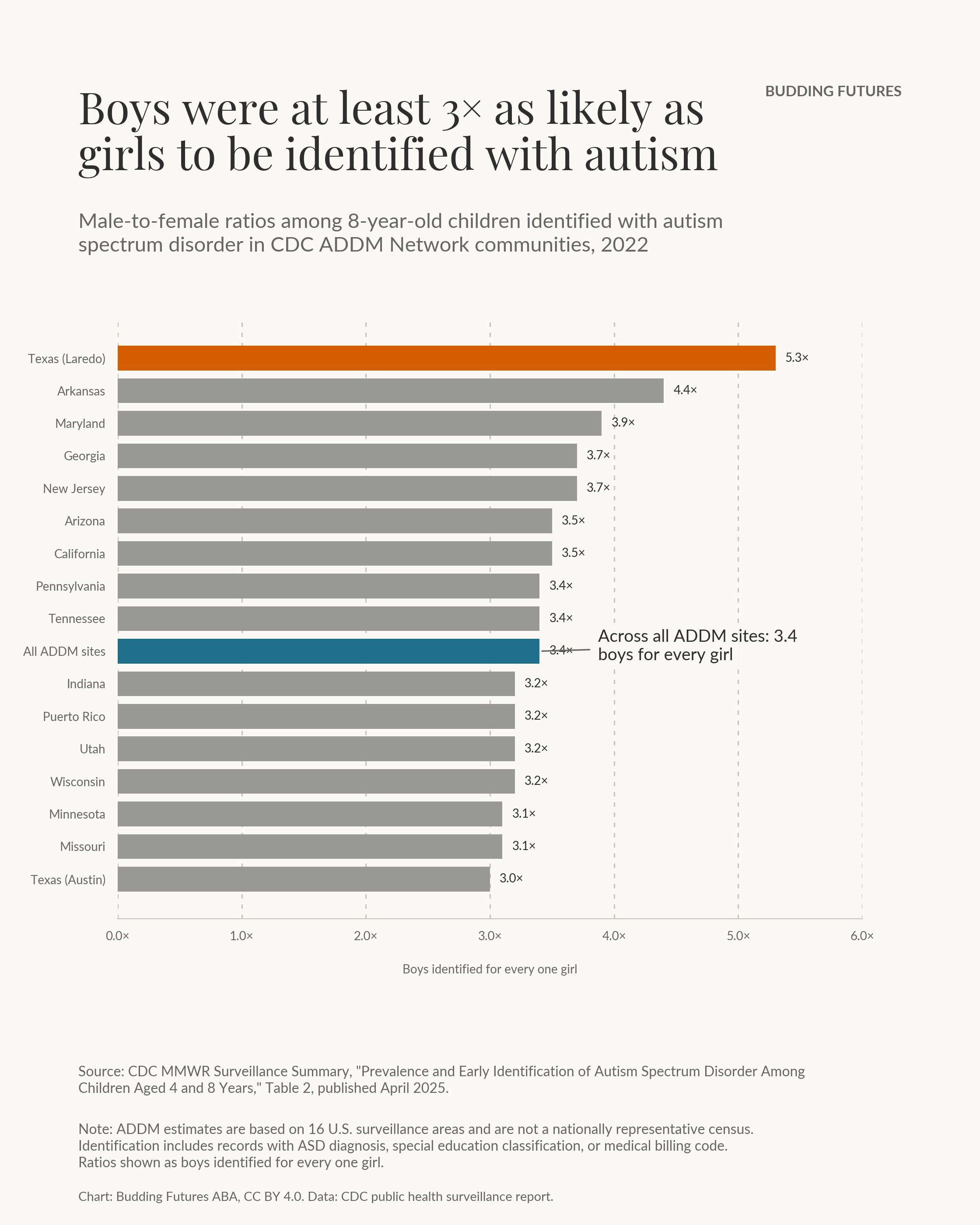
CDC ADDM Network, 2022 surveillance year, Table 2.
The chart
Plain-language takeaway: The boys-and-girls gap appears in every CDC ADDM community shown. The combined estimate was 3.4 boys identified for every girl, while site-level ratios ranged from 3.0 to 5.3.
How to read this responsibly
- This is about identified autism in records. CDC’s ADDM method can include an ASD diagnosis, autism special education classification, or ASD medical billing code in a child’s records.
- This is not a full national census. ADDM data come from selected surveillance areas, not every U.S. county or every child in the country.
- The ratio does not explain why the gap exists. Differences may reflect biology, evaluation access, school and medical documentation, local surveillance methods, and how autism presents in different children.
- The practical issue is identification. Families, schools, and clinicians need to notice communication, social, sensory, and daily-living needs early enough to connect children with useful support.
Source and method
CDC MMWR report
Prevalence and Early Identification of Autism Spectrum Disorder Among Children Aged 4 and 8 Years, ADDM Network, 16 Sites, United States, 2022.
Table used
Table 2: prevalence of autism spectrum disorder per 1,000 children aged 8 years, by boys and girls, race, and ethnicity.
Calculation
The chart uses CDC’s reported male-to-female prevalence ratio for each ADDM site and the combined ADDM estimate.
The chart should be cited as a visualization of CDC ADDM 2022 surveillance data, not as a claim that the ADDM communities represent the entire United States.
Questions parents often ask after seeing this data
Does this mean girls rarely have autism?
No. The chart shows identified autism in CDC surveillance records. It does not prove that girls rarely have autism, and it does not explain every reason girls may be identified at lower rates.
Should a parent wait because symptoms look “mild”?
No. If communication, daily routines, safety, school participation, or behavior are becoming hard, it is reasonable to ask a pediatrician, school team, or qualified provider what evaluation step fits next.
Where does ABA fit?
ABA is one possible support after a child’s needs are understood. At Budding Futures ABA, care planning is BCBA-led and focused on practical home goals, parent coaching, and skills that matter in daily routines.
Have questions after an autism diagnosis?
Budding Futures ABA provides in-home ABA therapy in Colorado with BCBA-led planning, parent coaching, and help understanding Medicaid or insurance steps.