
The ABA therapy controversy, measured
We read 1,910 opinions about ABA therapy posted in autistic-led Reddit communities and coded every one. Two thirds are negative. The people who actually went through ABA are the least absolute of anyone.
Three numbers
Those percentages come from 1,910 opinions that both take a position and name ABA, BCBA or RBT in their own text. Everything below is drawn from the same set.
Who is speaking changes the answer
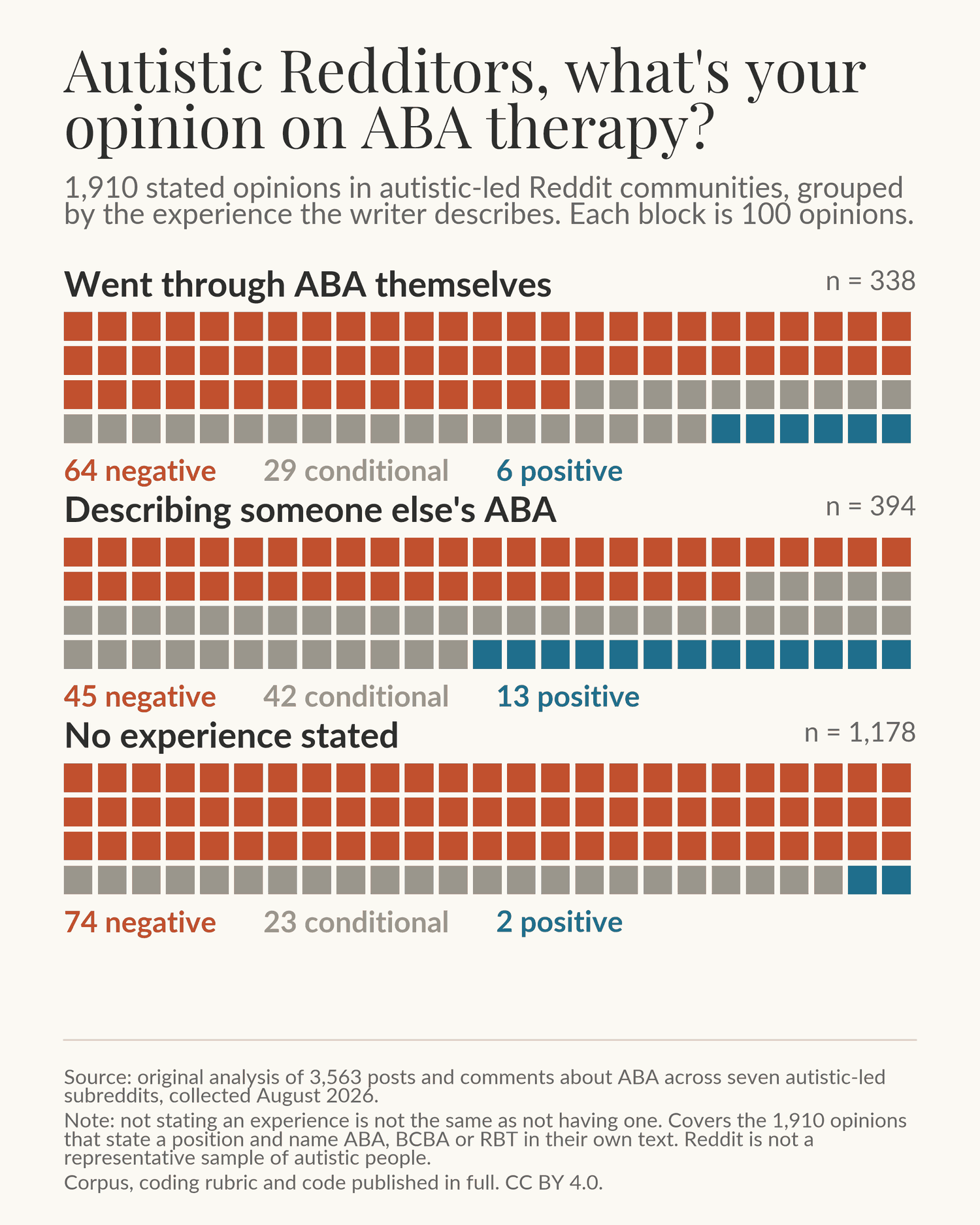
We coded whether each writer described going through ABA themselves, described someone else's ABA, or said nothing about experience. The gap between those groups is the clearest result in the data.
Tap or click the chart to open it full size.
The harshest opposition comes from writers who never mention experiencing ABA. People who went through it are 10 points less negative. People describing someone else's ABA are 29 points less negative, and are the only group where positive views reach double figures.
One caveat matters here. Not stating an experience is not the same as not having one, because short replies often leave it out. That group describes the text, not the person.
What the argument is actually about
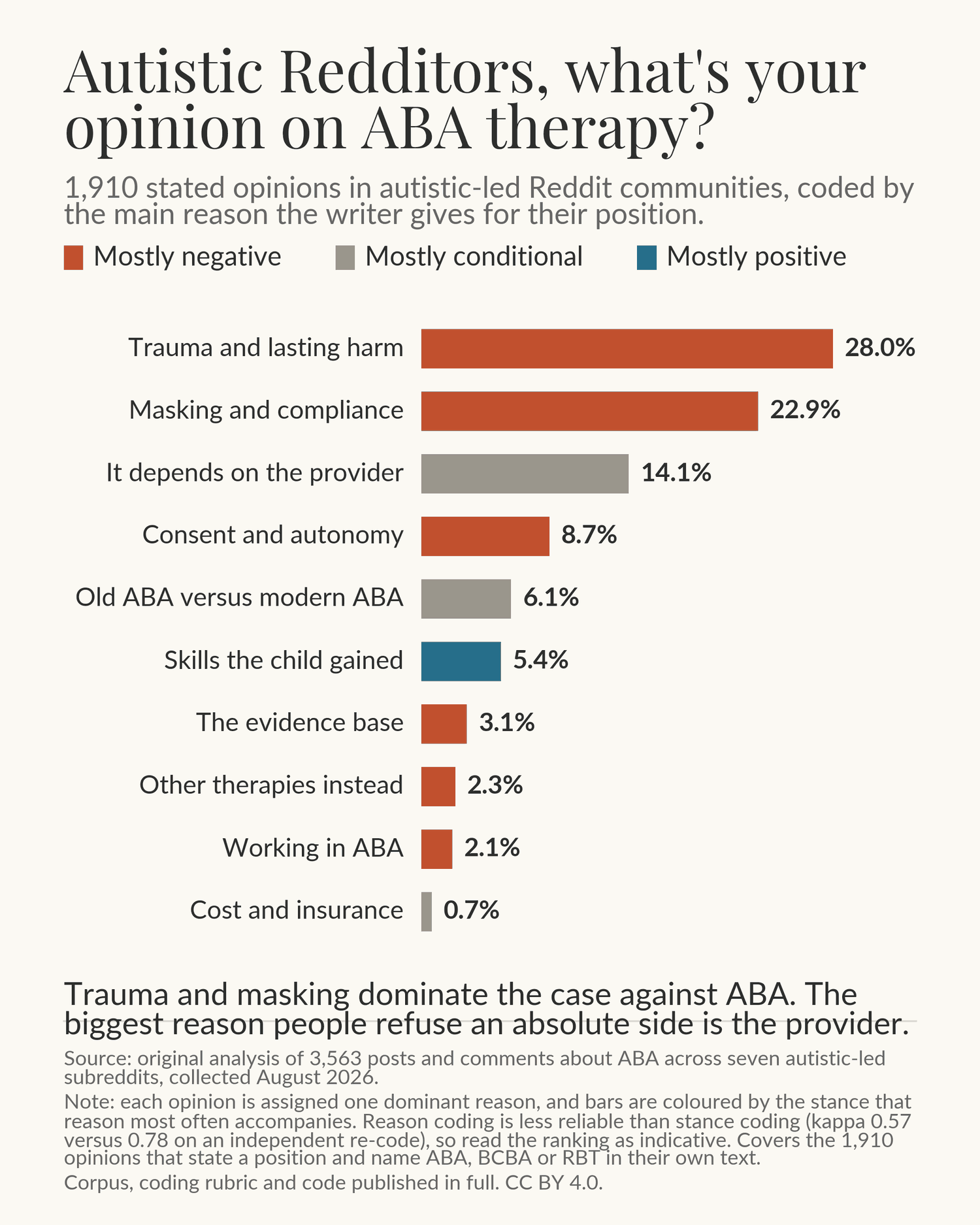
Each opinion was coded for the single dominant reason behind it. Trauma and masking carry the case against ABA. The most common reason for refusing to take an absolute side is the provider.
Tap or click the chart to open it full size.
Cost and insurance came last at 0.7%. In these communities the argument is about what ABA does to a person, not what it costs. That is close to the reverse of what we found in parent and practitioner communities earlier this year.
Reason coding is less reproducible than stance coding, so read this ranking as indicative. The reliability figures are in the methodology below.
Autistic Reddit does not speak with one voice
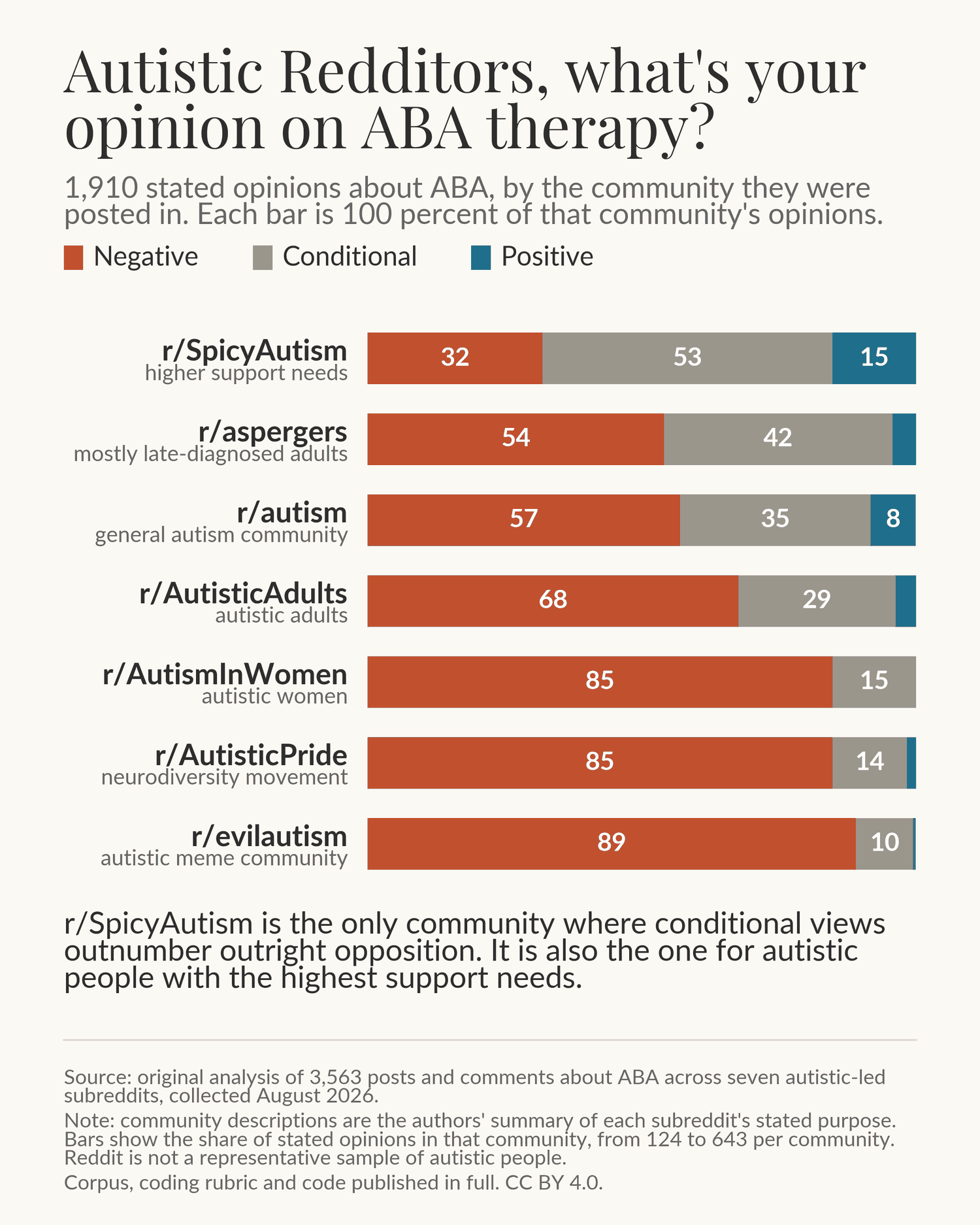
Splitting the same opinions by the community they were posted in produces the widest spread in the study.
Tap or click the chart to open it full size.
r/SpicyAutism is the community for autistic people with the highest support needs. It is the only one where conditional views outnumber outright opposition, and it has the highest share of positive views at 15%. At the other end, r/evilautism is 89% negative.
We are not claiming one community is right. The spread is the point: a parent who reads one thread and concludes they now know what autistic people think has sampled a single point on a very wide range.
How this was done
The whole study is published. You can re-run it, or re-code any opinion in it, and check whether you get what we got.
- Where the data came from. Public posts and top-level comments in seven autistic-led subreddits: r/autism, r/AutisticAdults, r/SpicyAutism, r/aspergers, r/AutismInWomen, r/AutisticPride and r/evilautism. Collected August 2026. Threads span July 2013 to August 2026.
- How threads were found. Three neutral searches, run identically in every community: "ABA", "ABA therapy" and "applied behavior analysis". No loaded words like abuse or trauma, so the sample is not pre-selected for outrage. That returned 1,044 threads, of which 574 named ABA in the title and were kept.
- What was counted. 3,563 posts and comments. Every headline figure uses the stricter subset of 1,910 that both state a position and name ABA, BCBA or RBT in the writer's own words, so no opinion is inferred from the thread around it.
- How it was coded. Each one was coded for stance, whether the writer described first-hand experience, whether they identify as autistic, and the main reason behind their view. Unlike earlier published work, conditional views were kept as their own category instead of being discarded.
- How we checked it. 300 randomly chosen opinions were re-coded independently, with no sight of the first pass. Agreement on stance was 88.0%, Cohen's kappa 0.806. On the reason categories it was 62.7%, kappa 0.567, which is why the reason ranking is presented as indicative. Both passes produce the same headline within two points.
- Privacy. No usernames, no comment text and no direct quotes are republished. The dataset carries public post ids and thread links so the original wording can be checked at the source.
What this does and does not show
It shows what these seven communities said about ABA between 2013 and 2026, and how sharply that varies by who is speaking and where.
It is not a survey of autistic people. Reddit skews toward people who write online, in English, and who choose to discuss therapy at all. Threads were found by keyword search rather than random sampling. Posting in an autistic community does not prove the writer is autistic, which is why only 28% are recorded as self-identifying. Nobody should read a percentage here as the share of autistic people who hold a view.
We publish this as an ABA provider, which is a real conflict of interest. It is why the searches are neutral, why we used the stricter denominator even though it lowers the negative share from 73% to 67%, and why the least flattering number in the study is the headline.
Sources
- This study's data. 3,563 coded posts and comments, collected August 2026 via the ScrapeCreators Reddit API. Corpus, coding rubric, scripts and reliability statistics available on request at info@buddingfuturesaba.com.
- Whisenhunt Saar, K., Saar, M., Bellon-Harn, M., Harn, W., Boyd, R., & Manchaiah, V. Upvote or Downvote ABA for Autism? Content and Support in Reddit Posts. The closest earlier study: 2,320 posts across 19 mixed subreddits, ending March 2020, split 47.9% pro-ABA and 52.1% anti-ABA. Read the paper.
- Bellon-Harn, M., Boyd, R., & Manchaiah, V. (2022). Applied Behavior Analysis as Treatment for Autism Spectrum Disorders: Topic Modeling and Linguistic Analysis of Reddit Posts. Frontiers in Rehabilitation Sciences. Read the paper.
- Aguirre Mtanous, N. G., et al. (2025). Mental health outcomes associated with applied behavior analysis in a US national sample of privately insured autistic youth. Autism. 17,120 autistic youth who received ABA matched against 17,120 who did not; ABA receipt was associated with 30% higher odds of a mental health hospitalisation. An association, not proof of cause, and the authors call for more work. Read the paper.
- Anderson, L. K. (2022). Autistic experiences of applied behavior analysis. Autism. Read the paper.
Read next
If you are a parent weighing this decision rather than studying it, these go further into the questions this data raises.
Questions about this report?
Families, reporters, and referral partners can contact Budding Futures with questions about the report, Colorado ABA access, or what transparent intake should include.
Talk to a BCBA about your child
Tell us what is hard right now. We will explain what in-home ABA could do, check your Medicaid or insurance, and give you a straight answer about next steps.